You scored the tickets. You booked the hotel. For weeks, that was the hard part – and you pulled it off. Now there’s one more decision that most World Cup fans in Miami are going to leave to the last minute, and it’s the one that will actually determine whether match day feels like a VIP experience or a sweaty, stressful ordeal.
How are you getting to Hard Rock Stadium?
On a normal Miami Tuesday, this is a non-question. You open Uber, you wait four minutes, you’re on your way. But FIFA World Cup match days in Miami are not normal Miami Tuesdays. With seven matches scheduled at Hard Rock Stadium between June 15 and July 18 – including a Quarterfinal and the Bronze Final – the transportation math changes completely.
This post breaks down both options honestly. Rideshare is not a bad product. But there are specific conditions under which it fails, and World Cup match days in Miami hit almost every one of them. Here’s what you need to know before you book your World Cup Miami limo service.
What Miami Match Days at Hard Rock Stadium Actually Look Like
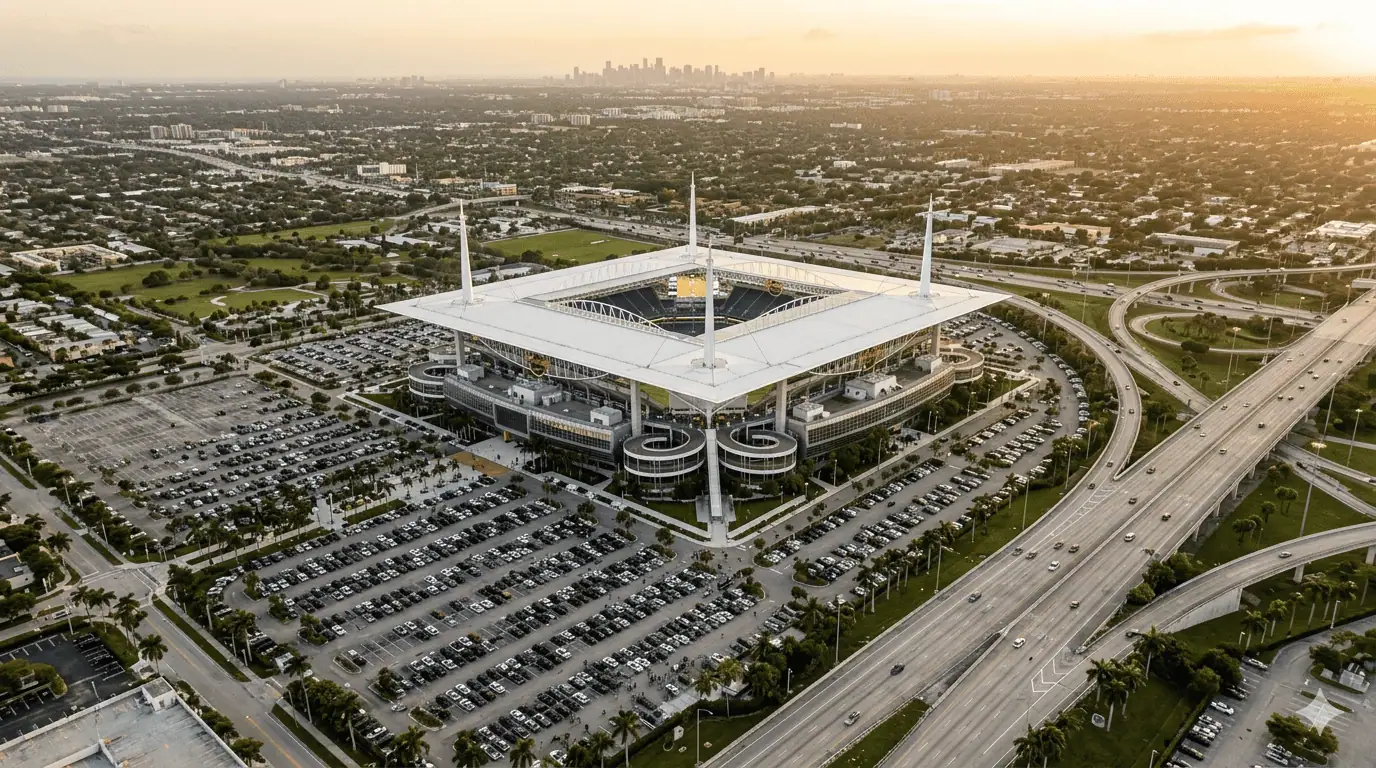
Hard Rock Stadium sits in Miami Gardens, roughly 17 miles north of Downtown Miami and about 15 miles from South Beach. It is a suburban stadium surrounded by major highways — the Florida Turnpike, I-95, and NW 27th Avenue are the primary approaches. There is no realistic walking route from any Miami hotel neighborhood. There is no subway stop at the door. Getting there requires a vehicle, and on match days, every one of the 65,000 fans inside that stadium is trying to solve the same problem at the same time.
This is not speculation. Miami has hosted events at this scale before. The Formula 1 Miami Grand Prix, multiple Super Bowls, and the 2024 Copa America final — which drew global attention for the crowd chaos outside the stadium — all ran through Hard Rock Stadium. On those days, the roads surrounding the venue locked up for miles. Drivers reported sitting on the Turnpike for 90 minutes after the event ended. Rideshare surge prices hit multiples that shocked people who thought they had budgeted for the trip.
Stadium parking, for what it’s worth, is already sold out. That option is off the table entirely for most fans.
The seven Miami matches — starting with Saudi Arabia vs. Uruguay on June 15 and running through the Bronze Final on July 18 — will each generate this same scenario. The Quarterfinal and Bronze Final will be worse, drawing higher-profile crowds and international media that compound the congestion.
This is the environment in which you are choosing your transportation.
The Case for Rideshare
Let’s be fair about this, because rideshare genuinely works well under the right conditions.
Uber and Lyft are familiar, easy, and require zero advance planning. On a standard Miami evening, a ride from Brickell to Miami Gardens runs $35–$55 and arrives in minutes. For a solo traveler on a tight budget who is staying close to the stadium, rideshare is a perfectly reasonable choice for the group-stage matches earlier in the tournament.
If you are staying in Miami Gardens itself — within two or three miles of Hard Rock Stadium — the calculus is different. Short distances mean shorter exposure to surge pricing, and post-game pickup is less chaotic when you are not fighting traffic from the other end of the city.
For fans attending one match and working with a limited budget, rideshare can get the job done. The key word is can.
Where Rideshare Breaks Down on Match Day
This is where the comparison gets real.
Surge pricing hits hard and fast. Rideshare pricing algorithms respond to demand in real time. When 65,000 people simultaneously open their apps after the final whistle — on a hot July night, in a stadium with patchy cell service — those algorithms respond accordingly. During the 2024 Copa America final at Hard Rock Stadium, social media filled with screenshots of post-game Uber quotes that bore no resemblance to normal Miami rates. This is not an edge case. It is how the system is designed to work, and World Cup matches will trigger it every single time.
Drivers avoid stadium events. Experienced rideshare drivers in Miami know what post-game Hard Rock Stadium traffic looks like. Many actively avoid the area on major event nights, which reduces supply precisely when demand is highest. The drivers who do accept stadium pickups are often less familiar with the venue layout and the post-event routing, which adds time.
The drop-off and pickup zones are not at the door. FIFA and Hard Rock Stadium designate specific rideshare zones that are a significant walk from stadium entrances. In June and July Miami heat — expect 88–92°F with high humidity on every match day — that walk matters. After a three-hour match with a full stadium experience, it matters more.
Post-game pickup is a genuine logistical problem. Finding a specific driver in a crowd of 65,000 people with degraded cell service is harder than it sounds. Your pin may not drop accurately. Your driver may circle. You may wait 30–45 minutes on a hot sidewalk while your phone battery drains, watching the surge price climb.
Flight delays are your problem, not theirs. If you are arriving from MIA or FLL on match day and your flight runs late, a rideshare driver will not wait. You start over from scratch in an already-congested airport, competing with thousands of other arriving fans for the same limited pool of available drivers.
On June 27, when Portugal vs. Colombia kicks off at 7:30pm, every one of these pressure points will be active simultaneously. That is not a match day to be improvising your transportation.
What a Limo or Private Car Transfer Actually Includes
A professional limo transfer is a different product category, not just a more expensive version of the same thing.
The rate is fixed and confirmed at booking. No algorithm touches it. What you agree to is what you pay, whether there are 10,000 fans trying to leave the stadium or 65,000.
If you are arriving from MIA or FLL, your chauffeur monitors your flight in real time. A delay of an hour does not leave you stranded — your driver adjusts and is there when you land. From the terminal, you go directly to your hotel or straight to the stadium, without competing for curbside availability against the surge of arriving fans.
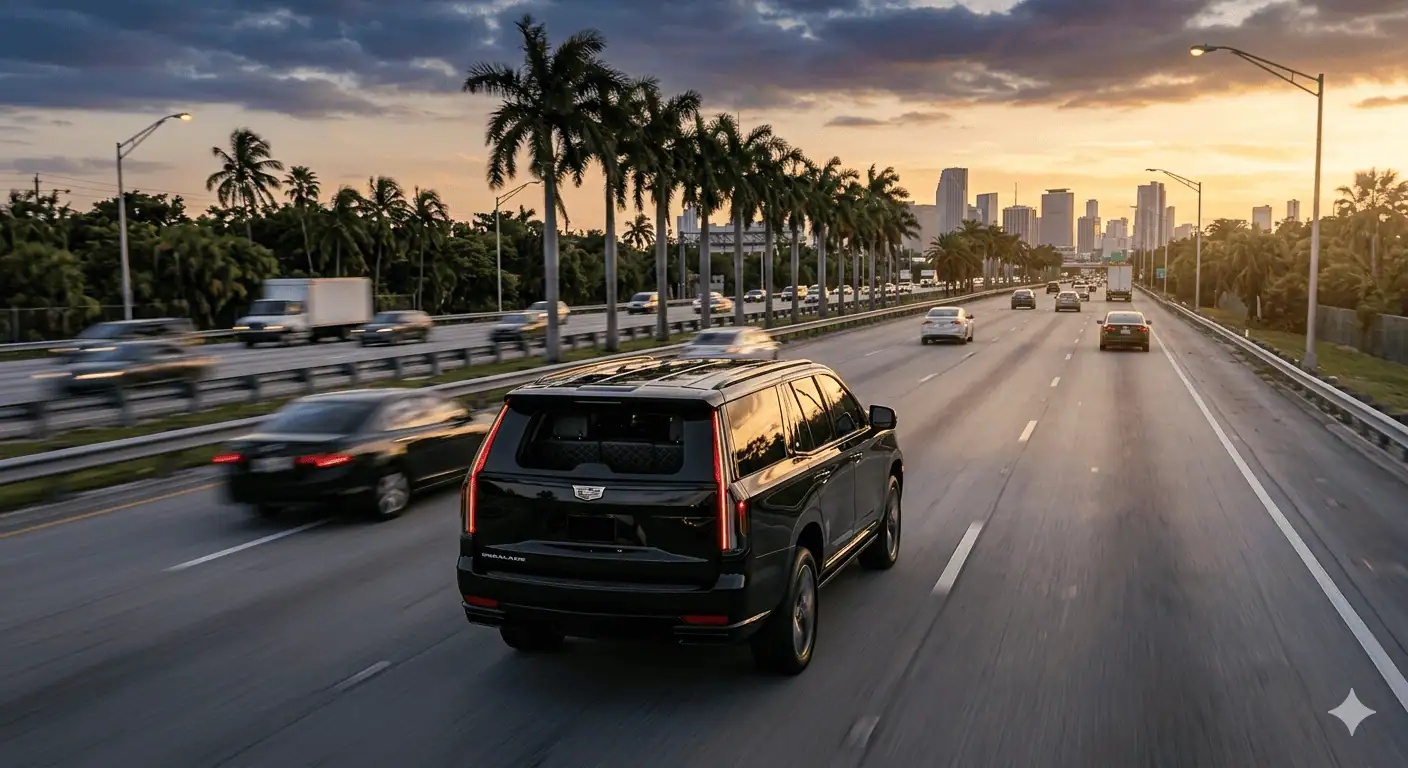
On match day, pickup is from your hotel lobby. The vehicle is climate-controlled, which is not a luxury in Miami in July — it is a genuine comfort consideration after a day of outdoor activity in South Florida summer heat. Your chauffeur knows the stadium approach routes, the access points, and how to time arrival to avoid the worst of the pre-game congestion.
Post-game, your pickup is pre-arranged. Your driver knows where to meet you and is there. You are not opening an app, waiting for a price to load, and then watching that price climb while you stand outside.
For groups, the math and the logistics both simplify significantly. One vehicle, one booking, one fixed cost, everyone together — no coordinating multiple rideshare trips or splitting across two cars because the group was too large.
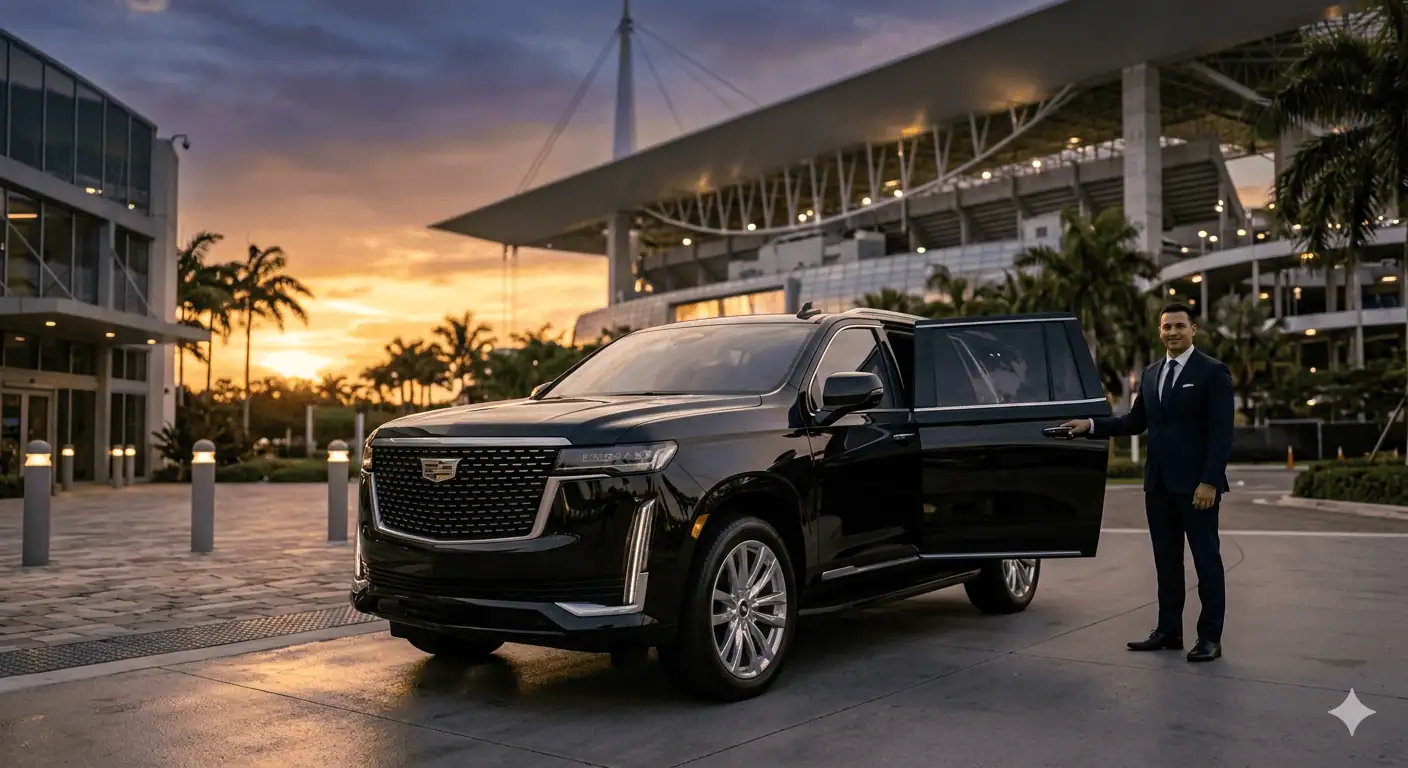
Metheora’s fleet covers every group size: the Cadillac Escalade ESV and Mercedes-Benz S-Class for smaller parties, and the Executive Sprinter Van for groups up to 14. Every vehicle is chauffeur-driven, every transfer is door-to-door.
Ready to skip the match day stress? Reserve your World Cup Miami limo transfer →
The Real Cost Comparison
Limo costs more upfront. That is true and worth saying plainly.
But the comparison is not limo rate vs. normal Uber rate. The comparison is limo rate vs. surge Uber rate, factored across your group, factored across both directions.
Consider a group of four friends attending the Quarterfinal on July 11. A round-trip Uber from South Beach to Hard Rock Stadium on a normal day might run $90–$110 total. On a major match night with surge pricing, that same route has historically run $60–$90 per ride in one direction. Round trip, for four people in two separate cars because one Uber won’t take the group, you are potentially looking at $300–$400 with zero certainty about wait times or post-game availability.
A private Cadillac Escalade ESV transfer for that same group — four people, hotel to stadium and back, fixed rate, chauffeur included — compresses that gap significantly. When you split it four ways, the per-person difference is often smaller than what you spent on stadium food.
The experience gap, however, is not small at all.
| Rideshare (Uber/Lyft) | Metheora Private Transfer | |
|---|---|---|
| Pricing | Variable – surge on match days | Fixed rate, confirmed at booking |
| Availability | Not guaranteed on match nights | Reserved in advance, guaranteed |
| Wait time post-game | 30–45 min average | Driver pre-arranged, meets you |
| Flight delay protection | None — driver cancels | Chauffeur monitors your flight |
| Group of 4 est. cost (round trip) | $300–$400 surged | Comparable when split 4 ways |
| Door-to-door service | Drop-off zones only | Hotel lobby to stadium entrance |
| Climate controlled | Depends on vehicle | Always |
| Booking window | Last minute | Book now — availability limited |
Who Should Book What
Rideshare makes sense if:
- You are traveling solo
- You are staying within 2–3 miles of Hard Rock Stadium
- You are attending an early group-stage match with a smaller crowd atmosphere
- Budget is the primary constraint and flexibility on wait times is acceptable
A limo or private transfer makes sense if:
- You are in a group of two or more
- You are staying in South Beach, Brickell, Wynwood, or Downtown Miami
- You are attending the Quarterfinal (July 11) or Bronze Final (July 18)
- You are entertaining a client or traveling with colleagues
- You are arriving from MIA or FLL on match day
- You want match day to be the experience — not the logistics
The Bottom Line
Your World Cup tickets cost hundreds of dollars. Your hotel cost more. You have invested real money in being part of one of the most significant sporting events Miami has ever hosted.
The transfer to and from Hard Rock Stadium is the part of that experience that either holds together or falls apart under pressure. Rideshare is a fine product on an ordinary day. World Cup match days in Miami are not ordinary days, and the gap between what rideshare promises and what it delivers on those specific nights is where a lot of fans are going to find themselves frustrated.
Metheora Limo has handled major event transfers at Hard Rock Stadium through Formula 1, Super Bowl week, and Copa America. We know the routes, the timing, and what match-day South Florida actually looks like from behind the wheel.
Availability for World Cup match dates is limited. If your match is on the calendar, the time to sort this out is now — not the week before.
Check availability for your match date →
Planning your hotels as well? Read our guide to the best Miami hotels for FIFA World Cup 2026 and how to get from each one to Hard Rock Stadium.
FAQ
Is Uber reliable for World Cup matches in Miami?
Uber works well in Miami under normal conditions. On World Cup match days at Hard Rock Stadium, surge pricing, reduced driver availability, and post-game congestion make reliability significantly less predictable than on a standard evening.
How much does a limo cost for Hard Rock Stadium transfers during the World Cup?
Rates vary based on vehicle, pickup location, and match date. Contact Metheora directly for a fixed quote — all World Cup transfer pricing is confirmed upfront with no surge adjustments.
How early should I book transportation for World Cup 2026 Miami?
As early as possible. Match dates – particularly the Quarterfinal (July 11) and Bronze Final (July 18) – will see vehicle availability fill up well in advance. Booking now secures your rate and guarantees availability.
Can a limo accommodate a large group for World Cup transfers?
Yes. Metheora’s Executive Sprinter Van accommodates groups up to 14 passengers in a single vehicle, keeping your group together and simplifying logistics significantly compared to coordinating multiple rideshare bookings.
I’ve never been to Miami – is it hard to get around during the World Cup?
Miami is a driving city with limited public transit, and World Cup match days will compress that challenge significantly. Pre-booking your transfers eliminates the guesswork entirely — you don’t need to know the city, the routes, or the parking situation. Your chauffeur handles all of it.