For business travelers, the airport you choose matters far more than the flight itself. A Fortune 500 executive arriving for a 9 a.m. board meeting doesn’t just need to land in Miami—they need to arrive at the right airport, at the right time, with ground transportation that delivers them to their destination composed and prepared.
Miami presents executives with a choice most cities don’t offer: three distinct airports, each serving different aviation needs and geographic priorities. Miami International (MIA) handles commercial traffic. Miami-Opa Locka Executive Airport (OPF) serves as the region’s premier business aviation facility. Tamiami Executive Airport (TMB) offers a southern alternative for private aircraft.
The right choice depends on your flight type, final destination, and how you value your time. This guide provides the intelligence you need to make that decision with confidence.
At-a-Glance Comparison
Before diving into specifics, here’s how Miami’s three airports compare on metrics that matter to business travelers:
| Factor | MIA | OPF (Opa-locka) | TMB (Tamiami) |
| Aviation Type | Commercial & Private | Private/Business Only | Private/Business Only |
| To Brickell/Downtown | 15-25 min | 25-35 min | 20-30 min |
| To Miami Beach | 25-40 min | 20-30 min | 35-45 min |
| To Coral Gables | 15-20 min | 30-40 min | 10-15 min |
| Crowd Level | High | Low | Very Low |
| FBO Options | Signature, Atlantic | Multiple Premium | Limited |
| Best For | Commercial travelers | Private jet, north destinations | Private jet, south destinations |
Miami International Airport (MIA): The Commercial Hub
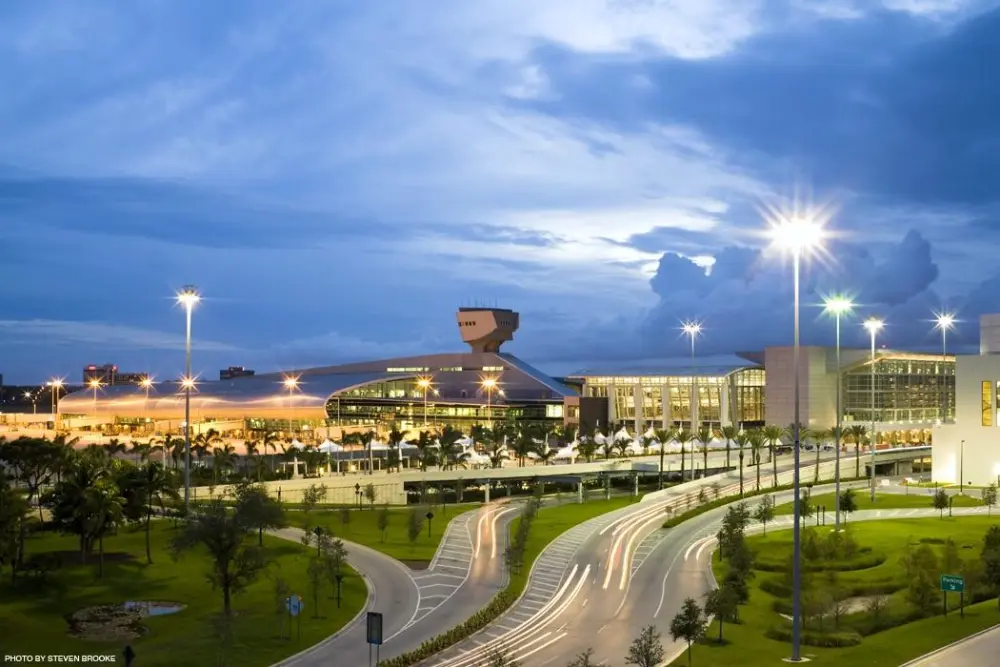
Miami International Airport handles over 50 million passengers annually, serving as the primary gateway between the Americas and Europe. For executives flying commercial—whether for airline loyalty benefits, specific route availability, or cost considerations—MIA remains the default choice.
When MIA Makes Sense
Commercial aviation offers advantages that even private flight can’t replicate. If you’re maintaining elite status with American Airlines (which uses MIA as a major hub), flying international routes only available commercially, or traveling with colleagues who need different connections, MIA serves those needs. The airport’s central location also provides relatively balanced drive times to most Miami business districts.
Navigating MIA Efficiently
The North Terminal houses American Airlines’ premium lounges and most international arrivals. For business travelers, the Admirals Club and Flagship Lounge offer workspaces and refreshments before flights. International arrivals should factor in customs and immigration time—typically 20 to 45 minutes depending on Global Entry status and passenger volume.
Peak congestion periods to avoid when possible include weekday mornings between 6 and 9 a.m. for domestic departures, Friday afternoons after 3 p.m. year-round, and seasonal surges during Art Basel (December), the Miami Open (March), and spring break (March through April). Domestic baggage claim typically runs 15 to 25 minutes post-landing.
Ground Transportation Logistics
Professional chauffeur services meet passengers in the arrivals hall after customs (international) or at designated pickup zones (domestic). The key to a smooth MIA pickup lies in communication: providing your driver with real-time flight updates, terminal information, and a description of where you’ll be standing eliminates the uncertainty that turns airport pickups into frustrating exercises.
For executives who value productive travel time, TSA PreCheck and Global Entry transform the MIA experience. PreCheck typically reduces security wait times to under 10 minutes; Global Entry can cut international arrivals processing to under 5 minutes via automated kiosks.
Bottom line: MIA serves commercial travelers well, but expect to budget 60 to 90 minutes from touchdown to vehicle departure for domestic flights, and 90 to 120 minutes for international arrivals.
Miami-Opa Locka Executive Airport (OPF): The Private Aviation Standard
For executives flying private, Miami-Opa Locka Executive Airport represents the region’s premier business aviation facility. Located in northern Miami-Dade County, OPF handles more business jet operations than any other airport in Florida—and for good reason.
Why OPF Dominates Business Aviation
OPF’s advantages begin with its FBO (Fixed-Base Operator) options. Atlantic Aviation and Fontainebleau Aviation both offer executive terminal services including private lounges, conference rooms, concierge assistance, and—critically—direct tarmac vehicle access. When your car meets you at the aircraft stairs, the transition from flight to ground takes minutes, not the better part of an hour.
The airport’s geographic position favors Miami’s most desirable business destinations. OPF sits closer to Miami Beach, the Design District, and Wynwood than any other airport option—a meaningful advantage when your meeting is at the Faena or you’re attending a client dinner in the Design District.
Time Savings Quantified
Consider a typical business trip comparison. Flying commercial into MIA: arrive 90 minutes before departure, clear security (15 to 45 minutes), board, fly, deplane, wait for bags (15 to 25 minutes), meet driver, navigate to vehicle. Total time from curb to curb adds roughly 3 to 4 hours to actual flight time.
Flying private into OPF: arrive at FBO 15 minutes before departure, board directly, fly, deplane to waiting vehicle. The same trip saves 2 to 3 hours on each end—time that translates directly to productivity, preparation, or simply reduced travel fatigue.
Ideal Client Profile
OPF serves executives who prioritize time efficiency and arrival experience. Fortune 500 C-suite travelers, international delegations requiring seamless logistics, and time-sensitive trips where every hour matters—these travelers consistently choose OPF. The airport can accommodate most business aircraft, including large-cabin jets, making it suitable for everything from a light jet carrying two executives to a Gulfstream bringing a full corporate team.
Bottom line: OPF delivers the business aviation experience executives expect—minimal friction, maximum efficiency, and an arrival that sets the tone for productive meetings ahead.
Tamiami Executive Airport (TMB): The Southern Alternative
Tamiami Executive Airport occupies a strategic position in southwest Miami-Dade County that makes it the optimal choice for a specific set of business travelers. While less prominent than OPF in business aviation circles, TMB offers distinct advantages for the right itinerary.
Geographic Sweet Spot
TMB’s location near the intersection of SW 137th Avenue and Coral Way places it remarkably close to Coral Gables, Coconut Grove, and South Miami. If your meetings are at the University of Miami, in the Coral Gables business district, or at one of the area’s premier country clubs, TMB shaves significant time off your ground transportation.
The airport also benefits from lower traffic volume than OPF, meaning fewer delays on approach and departure. For executives who value predictability—knowing exactly when they’ll land and exactly when they’ll reach their destination—TMB’s quieter operations provide that certainty.
Practical Considerations
TMB’s FBO services, while more limited than OPF’s, handle business aviation needs competently. The tradeoff: if your destination is Miami Beach, Brickell, or anywhere in northern Miami-Dade, TMB’s southern location works against you. The airport adds 15 to 20 minutes to northern destinations compared to OPF.
Bottom line: TMB excels for private aviation travelers whose itineraries center on southern Miami-Dade. It’s the wrong choice for Miami Beach meetings but the right choice for Coral Gables appointments.
Decision Framework: Matching Airport to Itinerary
Airport selection should follow a clear logic based on your specific travel parameters. Here’s how to think through the decision:
Choose MIA When
You should fly into Miami International if you’re traveling on commercial airlines (domestic or international), need specific routes or connections only available commercially, are maintaining airline loyalty status that provides meaningful benefits, or when budget considerations outweigh time efficiency for your particular trip.
Choose OPF When
Miami-Opa Locka Executive Airport is your best option when you’re flying private with destinations in northern Miami-Dade, Miami Beach, the Design District, or Downtown/Brickell. It’s the right choice when time efficiency is paramount, when you’re hosting clients who expect a white-glove arrival experience, or when multiple executives are arriving on the same aircraft and coordinated ground transportation matters.
Choose TMB When
Tamiami makes sense when you’re flying private with destinations in Coral Gables, Coconut Grove, South Miami, or Pinecrest. It’s ideal when you want to avoid the northern corridor entirely or when your meetings are concentrated in the southern half of Miami-Dade County.
The Ground Transportation Factor
Airport selection is only half the equation. The quality of your ground transportation determines whether the time you saved by choosing the right airport translates into actual productivity gains—or gets lost in the handoff between air and ground.
Executive ground transportation that monitors your flight in real time adjusts seamlessly to early arrivals or delays. Meet-and-greet services at the aircraft or terminal eliminate the uncertainty of finding your car. Professional chauffeurs who know Miami’s traffic patterns select routes that maximize your productive time in the vehicle.
The math matters: door-to-door time, not just flight time, determines your travel efficiency. An executive who saves 30 minutes by choosing OPF over MIA but then waits 20 minutes for a delayed car has captured only a third of the potential benefit. The airport and ground transportation decisions should be made together, with the same attention to seamless execution.
For business travelers who understand that arrival sets the tone for everything that follows, this integration isn’t a luxury—it’s a competitive advantage.
Insider Tips for Executive Travel Coordinators
Executive assistants and travel coordinators managing frequent Miami trips should keep these practical considerations in mind:
Lead times vary by airport. Private aviation at OPF and TMB typically requires less advance notice than you might expect, but FBO services and premium ground transportation benefit from 24 to 48 hours’ notice when possible. Last-minute bookings work but may limit options.
Communication prevents complications. Provide your ground transportation provider with tail numbers (private) or flight numbers (commercial), passenger counts, luggage volume, and any specific timing requirements. The more information shared upfront, the smoother the execution.
Weather diversions happen. South Florida’s afternoon thunderstorms can redirect flights to alternate airports. A ground transportation provider familiar with all three airports can adapt to diversions without disrupting your executive’s schedule.
Consistency pays dividends. Building a relationship with a single transportation provider creates institutional knowledge about your executives’ preferences, common destinations, and expectations. That familiarity compounds into smoother experiences over time.
Making the Right Choice
There’s no universally “best” Miami airport—only the best airport for your specific trip. The executive flying commercial from New York for a Brickell meeting has different optimal choices than the CEO arriving by private jet for a Coral Gables board meeting.
What remains constant is this: the airport decision deserves the same strategic thinking you apply to every other element of executive travel. Choose based on your actual destination, honest assessment of time value, and the ground transportation quality that will carry you from tarmac to conference room.
For business travelers who view time as their most valuable asset, getting this decision right is simply good business.
Planning executive travel to Miami? Our team specializes in seamless airport transfers from MIA, OPF, and TMB to any South Florida destination. Contact us to discuss your specific requirements.
Further reading
For airport logistics, see our guide to Miami Conference & Convention Guide.
Fort the best dinner and entertainment options, see our Executive Hospitality guide.
Learn more about our corporate travel services and airport transfers for convention attendees.